
3 Best ICF Pool Plaster Options (Worry-Free Waterproofing)
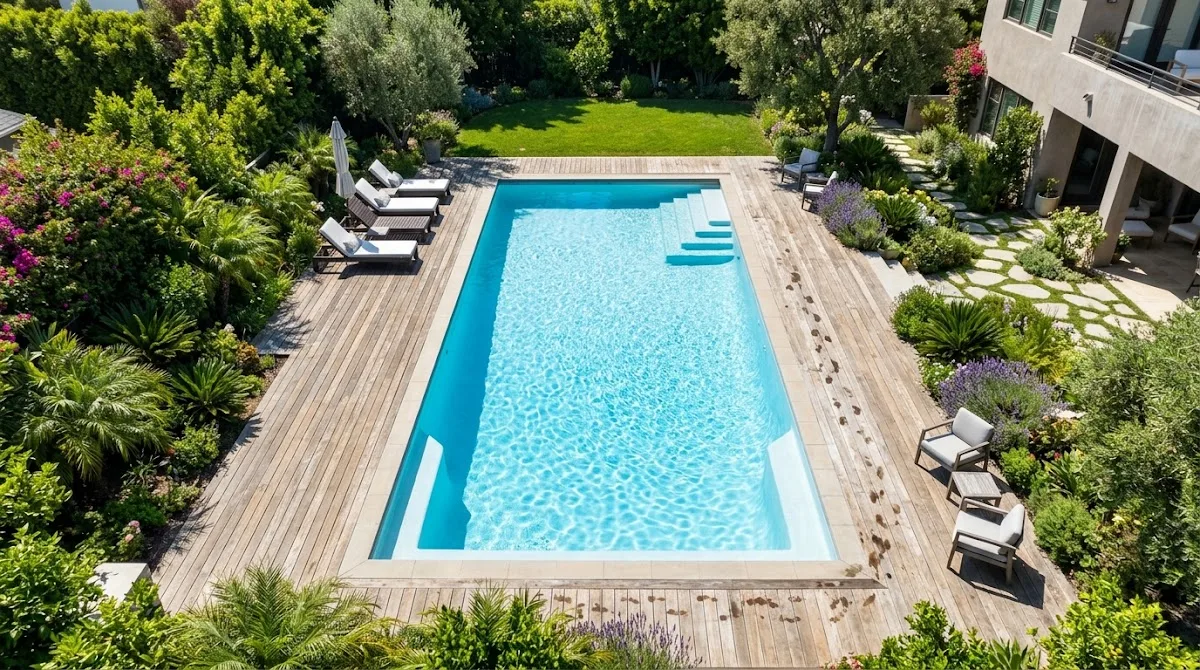
An ICF pool solves two big problems at once: heat loss and structural performance. But there’s a catch.
If the finish system fails, your pool can leak, stain, crack, or trap moisture where you don’t want it. This guide breaks down three leading options and a premium micro-ceramic alternative worth a close look.
The Rise of the ICF Pool: Why Insulated Concrete Forms Are Taking Over
An ICF pool is a swimming pool built with foam block forms that stay in place after the concrete pour. Those insulated concrete forms act as both structure and built-in insulation.
Why does that matter? Because water loses heat fast through the shell. A pool with insulated concrete forms helps insulate the vessel from surrounding soil, which can make an ICF pool up to three times cheaper to heat than some standard pool construction methods like gunite or cast-in-place concrete.
That savings adds up. In many installs, owners report up to 60% lower water-heating costs. The insulation around the pool walls helps hold temperature longer, especially in cooler ground conditions.
There’s another benefit people miss. During ICF pool construction, the forms help keep rebar in place during the pour. That can reduce movement and limit cold joints when the shell is poured monolithically.
In other words, you get energy efficiency and durability in one build approach.
If you want a deeper look at the basics, this guide to the ICF swimming pool process is a useful place to start.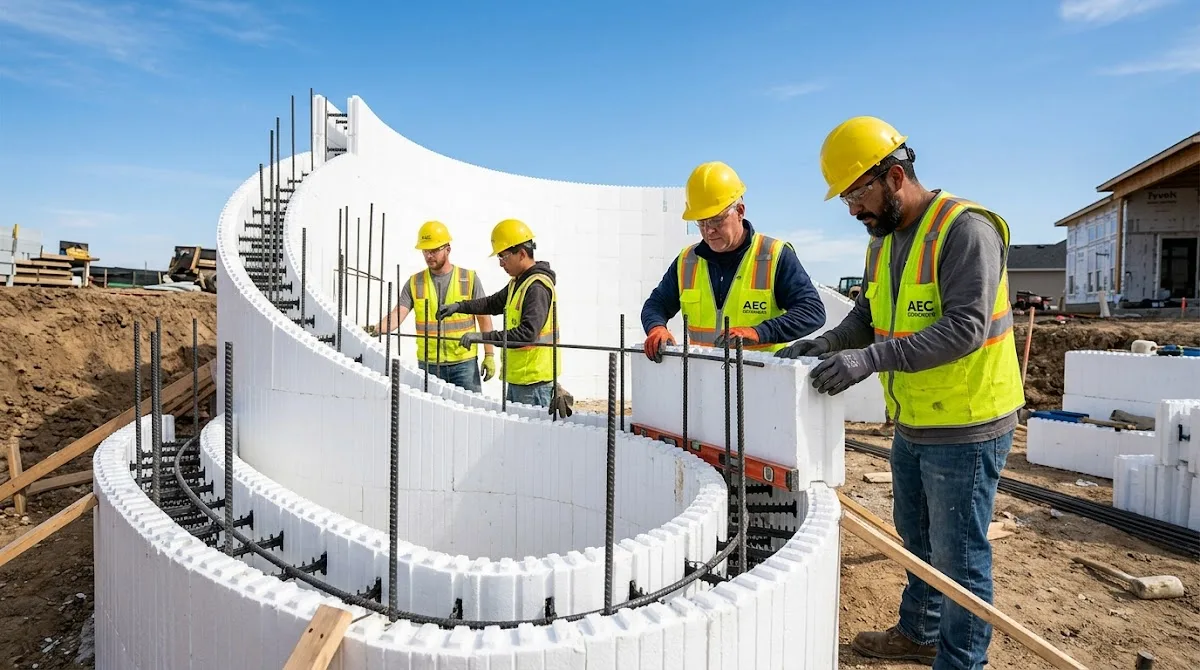
ICFs also bring design flexibility. Curves, straight runs, vanishing edges, benches, and raised details are often easier to plan than with older masonry or stucco-heavy methods. That’s one reason ICF construction keeps showing up in custom homes, community pools, and even select commercial buildings.
You’ll also see systems from more than one ICF manufacturer, including names like Fox Blocks and Nudura. Some projects even use a one-sided ICF form where site conditions demand it.
Core Waterproofing Needs to Insulate and Protect Concrete Forms
Here’s the hard truth: not every wall finish belongs in a pool.
An insulated concrete form pool is not just a retaining wall that happens to hold water. It has to be a fully waterproof vessel. That means the coating needs to do more than look good. It must create a real waterproof barrier.
Pool chemistry makes the job harder. Chlorine, changing pH, sun, freeze-thaw movement, and constant immersion put stress on pool surfaces year-round. Add thermal swings and wet-dry cycles near the perimeter, and weak materials start showing problems fast.
A good system should last at least 10 years. Ideally longer. If not, the pool can face:
- Water leaks
- Mold growth behind finishes
- Alga buildup
- Surface staining
- Damage near the subgrade
This is where many builder teams start comparing plaster, liner, and membrane approaches. A vinyl liner or other pool liner can work in some above- and below-ground pools, and ICF vinyl systems do exist. But many people want a harder, more seamless interior than a vinyl liner offers, especially in a concrete pool feel.
For that reason, many turn to pool waterproofing systems made specifically for ICFs and long-term immersion.
The 3 Best ICF Pool Plaster Options on the Market
Choosing the best ICF finish is really about tradeoffs. Prep work, climate, texture, color control, crack handling, and installation speed all matter.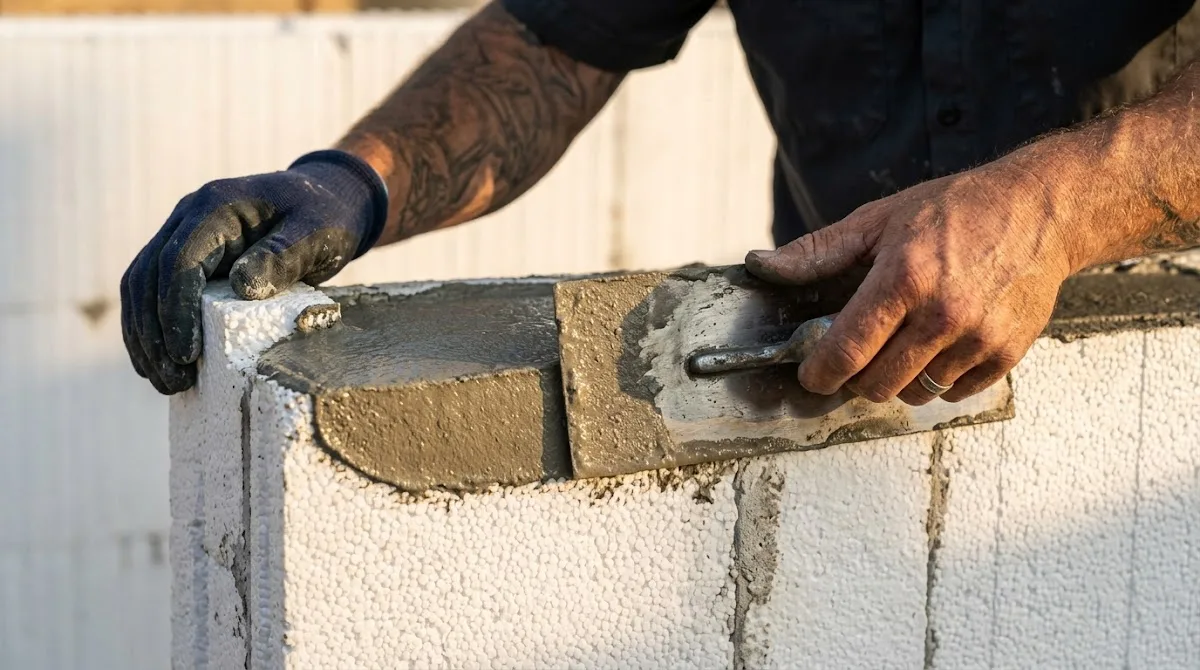
Here are three established choices.
1. Basecrete: A Versatile Pool Coating and Bondcoat
Basecrete is a cementitious waterproofing membrane used as both a pool coating and bondcoat. It has tested adhesion to EPS foam, which matters in an ICF pool wall where the finish must lock onto the form face reliably.
Application is flexible. An installer can use rollers, spray gear, or a trowel depending on site conditions and crew preference.
The typical system uses two layers with mesh between them. After that, the pool usually receives a traditional pebble or plaster finish over the top. In practice, that means more steps, but also a familiar workflow for pool companies already used to layered systems.
Basecrete is often chosen because it has multiple ASTM tests tied to adhesion, abrasion resistance, and color stability. If you’re comparing options for ICF pool plaster, that track record is part of the appeal.
2. Sider-Crete Sider-Proof FF-PR: The Original Roll-On ICF Pool Plaster
Sider-Crete Sider-Proof FF-PR is a cement-based, polymer-modified waterproofing plaster made for low-prep application. That’s a big reason it gets attention in cold regions.
The polymer modified formula improves freeze-thaw performance. It also works in chlorine and saltwater pool environments, plus spas and waterfall features.
There is a catch. You need a specialized base coat called Powerbase before the finish layer goes on. That basecoat helps bridge hairline cracking and smooth the surface. For some crews, that’s fine. For others, it adds labor they were hoping to avoid.
Still, Sider-Crete remains one of the better-known names in the cement plaster system for ICF category.
3. Durock Pool-Kote: A High-Strength Option for Insulated Concrete
Durock Pool-Kote is a dense cement-based finish comprised of white Portland cement, quartz marble aggregate, and mineral fillers. It is built for strength first.
That dense matrix gives the system strong compressive, tensile, and flexural performance, plus low shrinkage. Structurally, that matters when an ICF pool sees temperature swings and constant hydraulic pressure.
The application process is more exacting. It usually requires two layers of base coat and mesh, then a primer, then a strict wait time before the final coat. Done right, Durock cures to a hard, smooth, water-resistant surface with solid freeze-thaw resistance.
For some jobs, that hardness is a plus. For others, it can make repair details less forgiving.
The Premium Alternative: SKIN2.0 Micro-Ceramic Pool Coatings
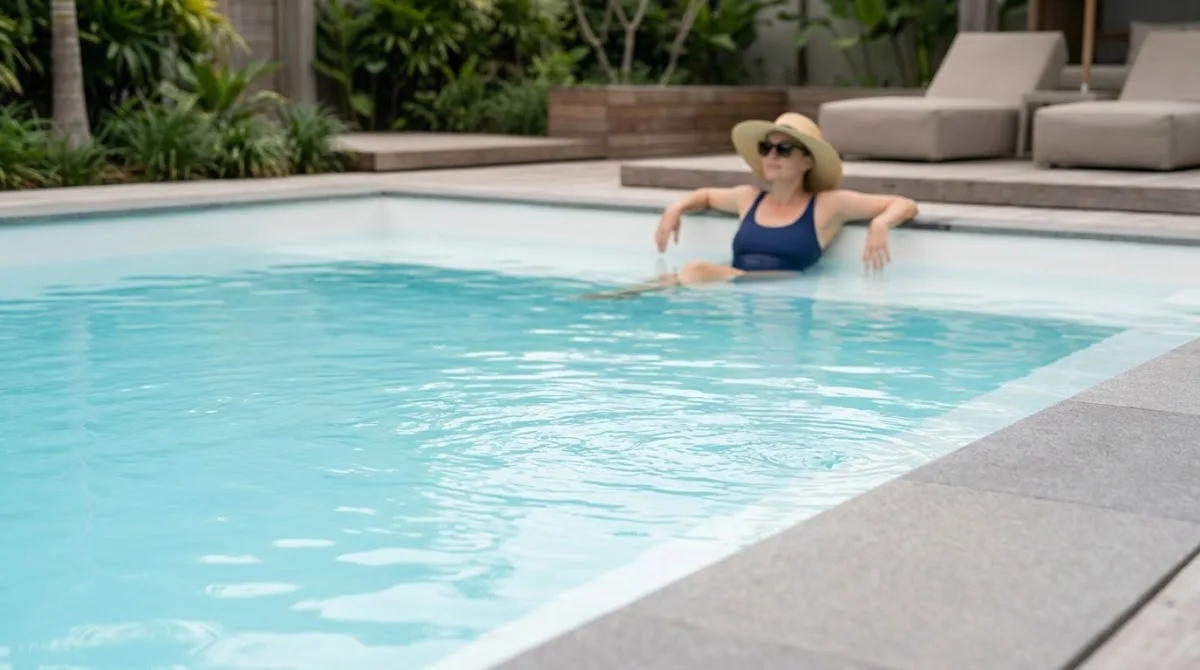 Now for the part many teams are watching closely.
SKIN2.0 is a three-part micro-ceramic waterproofing cement plaster system and luxury finish for a pool, spa, and wider construction use. Unlike thick plaster systems, it creates a waterproof shell with a highly efficient 1/16-inch top layer after the reinforced base.
That changes a lot.
The system uses a live synthetic liquid with micro-bead porcelain for excellent color consistency between batches. It is also ASTM, NSF, and Miami-Dade NOA certified, which speaks directly to durability and compliance.
Just as important, SKIN2.0 is antimicrobial, antibacterial, and antiviral. In a pool environment, that gives the coating a hygiene advantage beyond standard plaster finish systems.
It also helps that the finish is chemical resistant and refined in appearance. Compared with older pool coatings, it asks for less bulk while still delivering a strong waterproof result.
If you’ve seen older methods that rely on flexible ICF mesh reinforced layers, coats of epoxy, stucco detailing, or even a polyurea finish, this feels like a cleaner evolution. It is not a liner. It is not fiberglass. And it avoids the look limitations that can come with a pool liner.
Even better, the system is comprised of a flexible ICF-ready shell approach suited for modern ICF pool construction.
Comparison Table: Analyzing the Best ICF Solutions
| Feature | Basecrete | Sider-Crete Sider-Proof FF-PR | Durock Pool-Kote |
|---|---|---|---|
| Composition | Cementitious waterproofing membrane | Cement-based, polymer modified | White Portland cement, quartz marble aggregate |
| Application Method | Rollers, trowels, or spray | Roll-on | Base coat, prime, then trowel |
| Key Advantage | High adhesion to EPS foam | Covers hairline cracks, standard/custom colors | Dense matrix, high tensile/compressive strength |
| Climate Resilience | Highly flexible | Superior freeze-thaw resistance | Superior freeze-thaw resistance |
A quick note here. Some owners compare these systems to Pebble Tec style finishes because they know the pebble look. Fair enough. But in an ICF pool, waterproofing performance has to come first, then texture and color.
Fox Blocks Case Study: Achieving Fast, Cost-Effective Results
One Fox Blocks case study involved a 382 square-foot Ranch House pool in Mathis, Texas. The design used radius blocks to create a wine-barrel-shaped curve without heavy manual forming.
The ICF block install was completed over a five-day weekend. Total cost came to $19,450, roughly half the cost of more conventional pool builds.
That’s the larger point. An insulated concrete build can move quickly, control labor, and simplify forming. When the shell is paired with the right waterproof finish, the result is a pool that performs the way it should.
Conclusion
The best ICF pool finish depends on your priorities: speed, crack resistance, texture, or long-term waterproofing. Basecrete, Sider-Crete, and Durock each bring something useful to the table. But if you want a thinner, certified, health-conscious system with luxury appeal, SKIN2.0 deserves a serious look for your next pool.
Frequently Asked Questions About ICF Pool Plaster
What is ICF pool plaster?
ICF pool plaster is a finish system made for a pool built with insulated concrete forms.
Is an ICF pool better than a vinyl liner pool?
It depends on goals. An ICF pool usually offers a harder interior and better thermal performance.
How long should pool plaster last on ICFs?
A quality system should last 10 years or more with proper installation and care.
Can I use standard plaster on an ICF swimming pool?
Sometimes, but not every plaster system bonds well to ICFs or performs as a waterproof finish.
Why is waterproofing so important in an insulated concrete form pool?
Because the shell must hold water completely and protect the structure from leaks and moisture damage.