
ICF Swimming Pool: Build Guide (w/ Costs & Pros/Cons)

An ICF swimming pool looks simple from the outside. Under the surface, though, it solves some of the biggest problems in pool construction: heat loss, schedule delays, finish failure, and hard-to-build shapes.
This guide breaks down how ICF pools work, what they cost, where they shine, and where they fall short.
What Is an Insulated Concrete Form Swimming Pool?
An insulated concrete form swimming pool is a pool shell built with hollow reinforced foam forms that stack together and are later filled with concrete. Most systems use EPS, or expanded polystyrene, to create the wall forms.
Think about it this way. Instead of building temporary forms and stripping them away, the forms stay in place and become part of the shell. That means ICF construction combines structure and insulation in one system.
This approach has been around for decades. Documented panelized installations date back to June 1970. Modern systems are more refined, of course, but the basic idea is proven.
Some ICF blocks interlock and can create arcs of 2’, 4’, 8’, 12’, 16’, and 20’. That makes custom design work much easier. A builder can create a curve, tanning ledge, spa, or unusual radius without the same labor burden found in other pool construction methods.
Just as important, ICF walls create a flat substrate. That matters more than many people realize. A smoother base helps waterproof layers bond better, helps the final finish look cleaner, and can reduce surface defects later. If you’re comparing interior systems, this is where advanced ICF pool finishes start to stand apart.
5 Advantages of Building an ICF Swimming Pool
1. Creating a Highly Efficient Pool System
The biggest selling point for many homeowners is energy performance. ICF pools can reduce ongoing energy costs by up to 60% compared to traditional concrete pools.
Why? Because a pool loses a surprising amount of heat into the ground. According to ICF Magazine, about 80 percent of a pool’s heat escapes through its bottom and sides because the surrounding earth conducts heat better than surface air.
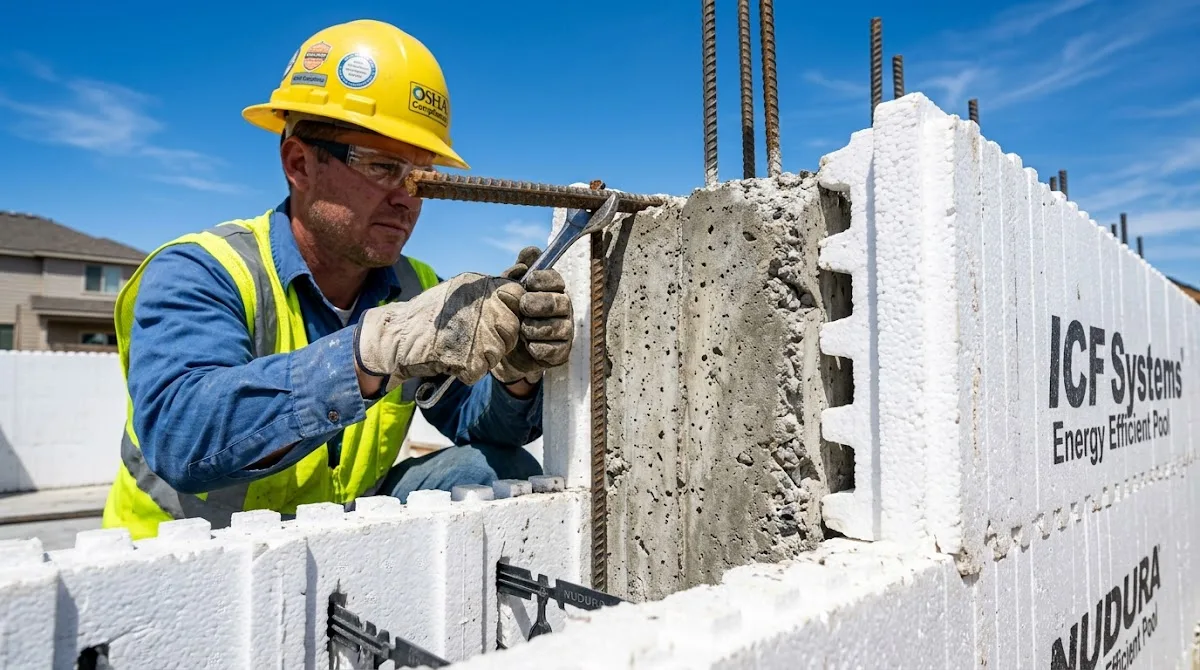
ICFs help insulate the shell continuously. That can stabilize water temperature, reduce energy consumption, and extend the swimming season in colder climates. In practical terms, you get a more energy-efficient, efficient pool with lower heating demand.
There’s also a technical point worth noting. Continuous insulation, as defined by ASHRAE 90.1-2013, means the insulation layer is uncompressed and free from thermal bridges. That is exactly the kind of setup that helps ICF pools offer better energy-efficiency and real savings over time.
2. Long-Lasting Durability for the Concrete Form
ICF pools pair a solid concrete core with EPS foam on each side. That gives the shell impressive durability and a level of protection that is hard to ignore.
The foam acts as a barrier against ground moisture infiltration. It also helps shield the concrete from repeated thermal stress. Over time, that can reduce cracking pressure and help the shell withstand harsh site conditions, including freeze-thaw cycles and even earthquake exposure in the right engineered assembly.
Another plus is that the materials are mold resistant. That can mean fewer maintenance headaches and a longer-lasting structure for years and years to come. For a homeowner, that usually translates into lower repair risk and greater confidence in the build.
3. Streamlined Construction for the Pool Contractor
This is where the method becomes very attractive on the jobsite. ICF blocks are light, easy to move, and simple to stack. Most crews do not need heavy lifting equipment to set the wall block in place.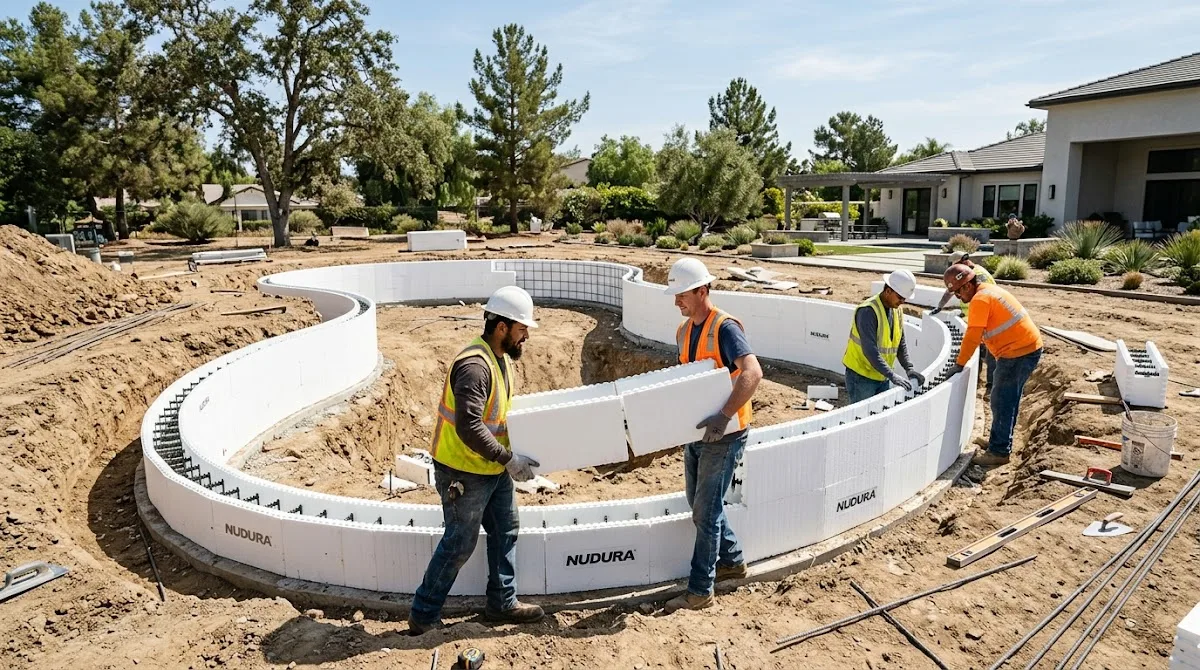
That changes the construction process. Excavation can be more forgiving. If the dig is a little over, crews can backfill around the set walls. Scheduling also becomes easier because the project does not depend on securing a spray crew at the exact right moment.
In many cases, ICF pool construction is a faster process than traditional shell methods. That can reduce labor pressure, reduce idle time, and improve profitability. For a contractor or builder trying to keep a clean schedule, that predictability is a real advantage.
4. Unlimited Design Versatility for the Builder
Some systems are fine for rectangles. They struggle the moment a designer asks for complexity. ICFs do not have that problem.
Because the forms are modular and easy to cut, builders can integrate benches, raised spas, vanishing edges, catch basins, and unusual transitions with less waste and less site stress. Above-ground, below-ground, and in-ground designs are all possible.
That flexibility makes ICFs useful across residential and commercial work. They fit custom homes and commercial buildings just as well as they fit backyard retreats. If a builder wants freedom without giving up structural performance, insulated concrete systems make a strong case.
5. Smooth Walls Ideal for Luxury Finishes
Finish quality often comes down to substrate quality. If the pool walls are uneven, the final surface will show it.
ICF pools create a flatter, smoother base than many sprayed shells. That can reduce visual imperfections, reduce liner issues, and reduce the risk of water seepage showing up as a finish problem later.
This is exactly why high-end teams pay attention to waterproof layers and surface systems. A refined shell deserves a refined interior. If you want to understand why that matters for the pool environment, this guide on pool health explains the role of microplaster and waterproof protection clearly.
Step-by-Step ICF Pool Construction Guide
Here’s the standard workflow used in professional installation. The method is straightforward, and multi-depth ICF pools are easy to plan by pouring horizontal slabs first and using them as guides for sloped sections.
| Step | Phase | Key Actions & Details |
|---|---|---|
| 1 | Excavation | Dig the pool footprint. It does not require exact tolerances like many other construction systems. |
| 2 | Footings | Form and place concrete footings according to engineering. |
| 3 | Stacking Walls | Stack the ICF blocks to the required height around the perimeter. |
| 4 | Reinforcement | Install rebar, brace the forms, and follow structural engineering specs. |
| 5 | Bottom Prep | Add smooth sand fill, then an underslab moisture barrier and rigid foam insulation at the bottom of the pool. |
| 6 | Floor Steel | Tie in floor steel with the wall reinforcement. |
| 7 | Concrete Pour | Pour the slab and complete the shell. Protect drains, lights, skimmer openings, plumb lines, and electrical points from blockage. |
Simple on paper, right? In practice, good installation still matters. Pools require careful detailing around penetrations, transitions, and waterproof interfaces. That is where a professional team and a reliable manufacturer spec make a big difference.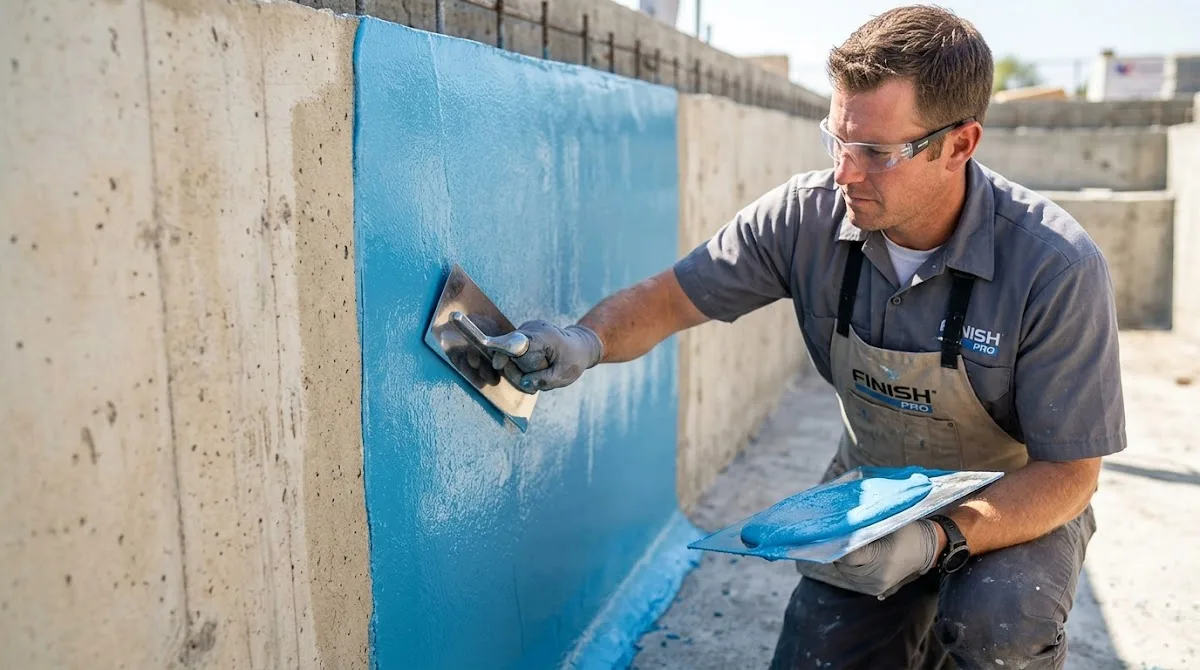
Comparing Finish Options for Insulated Concrete Pools
Traditional Options: Shotcrete, Vinyl, and Polymer
Not every finish works the same way over ICF walls.
Spray-applied concrete usually needs metal lath attached to the foam to control movement. It may also use fiber reinforcement, then a separate plaster coat on top. Vinyl uses a liner secured at the top of the wall, but liners often need replacement in about 10 years. Cement-based polymer systems go on more like acrylic stucco, using mesh, a basecoat, and then color.
Each option has tradeoffs. Some are cost-effective at the start. Some are easy construction choices. But compared to other pool interiors, they may offer far greater upkeep or shorter service life.
The Ultimate Upgrade: Proprietary Micro-Ceramic Systems
High-end ICF pools deserve more than a basic interior finish. Smooth, insulated concrete shells are built to last, so the inside surface should match that standard.
That’s why many teams move beyond standard pool plaster and choose a proprietary micro-ceramic waterproof system. SKIN2.0 is designed for this type of application, combining waterproofing and luxury finish performance in one high-quality system.
There’s also the compliance side. ASTM, NSF, and Miami-Dade NOA certifications matter. So do antimicrobial, antibacterial, and antiviral properties. For the consumer, that helps secure confidence in both hygiene and durability. If you’re weighing lifespan, this overview of plaster longevity is worth reading.
Conclusion
ICF pools combine insulation, concrete strength, design freedom, and faster installation in one system. They can reduce heat loss, lower energy costs, and create a smooth shell ready for a better waterproof finish. If you want a longer-lasting swimming pool with fewer surprises, ICF construction is a smart path to consider.
Frequently Asked Questions About ICF Swimming Pool
Are ICF pools worth it?
Yes, especially if you value energy savings, design flexibility, and durability.
Can you use ICF to build a pool?
Yes. ICFs are widely used to build in-ground pool shells.
What are the drawbacks of ICF Foundation?
Higher material cost and the need for crews who understand the system.
Can you put drywall directly on an ICF?
Inside buildings, yes, with proper fastening systems. It is not relevant to pool interiors.
What are the cons of ICF?
Planning details matter, and some finishes are better suited to ICFs than others.
Can you put drywall directly on an ICF?
Yes, in building construction with the right attachment method.